Tuesday, 16 February 2016

Boost your employability with our Keynote trial

There is currently a trial to Keynote until the 6th April 2016.  This database is a great resource for all students across all disciplines.  It’s easy to navigate and allows students to research potential employers before interviews.

In summary:

·         Research a company (UK) – includes financials, key contacts

·         Analyse a markets strengths and weakness

·         Current issues that may impact on future employer/market place

·         Future trends and developments with 5 year forecasts

·         Research opportunities for new business growth

·         Relevant for all students’ employability across the University.

Access the trial on campus (VPN off-campus): https://www.keynote.co.uk/content/employability  or www.keynote.co.uk

Thursday, 11 February 2016

Tickell Independent Review of Progress in Open Access Models


Published on 11 February 2016, this independent review of recent progress in the Open Access publications market "Open Access to Research Publications: Independent Advice", commissioned by the UK Government and authored by Adam Tickell, Vice-Principal of the University of Birmingham, summarises the current position on Open Access and makes recommendations as follows:

i) The UK Government should continue supporting the Gold Open Access model but should note that few research funding bodies internationally have an explicit preference for the Gold model and that the vast majority of funders support Green OA, with flexibility for authors to publish via Gold if they wish and have the funds available.

ii) Business models for Open Access journals publishing have proved less responsive to market pressures than envisaged and costs continue to rise, with there being a ‘consistent and sharp’ increase in the average cost of purchasing Gold Open Access papers and corresponding falls in subscription costs not being commensurate. The costs of driving a strong preference for Gold OA could rise from £33m in 2014 to between £40-£83m by 2020, with around three-quarters of this rise being due to inflation of OA Article Processing Charges in hybrid subscription/open access titles

iii) Whereas the UK is widely recognised as being the leading nation in the Open Access and Open Data movements, the journal publications market has a global reach. As such, UK Open Access policy developments must be considered in light of international approaches and preferences.

iv) That all UK universities should sign up to the San Francisco Declaration on Research Assessment (DORA) at http://www.ascb.org/dora/ to ensure that the pressures of research quality assessment (e.g. REF) do not place too much inflationary pressure on the Gold Open Access market.

v) That the UK Open Access Coordination Group should support the development of agreed service standards around Gold Open Access, in recognition of concerns about poor service and market response from some publishers.  To support this objective, the Group should convene an Efficiency Forum sub-group to look at OA market operation, a Repositories sub-group to ensure continuing inter-operability between UK repositories, and an OA Monographs sub-group to develop policies for open access in the book market.

vi) Open Access to research data has developed more slowly than for research publications. The Concordat on Open Research Data will be finalised in early 2016, and while there are major scientific and public good advantages in pursuing open research data, the cost implications surrounding the distribution of such data to the commercial sector are not yet fully understood.

vii) The UK Open Data Forum should coordinate work relating to furthering the Research Data Management roadmap in the UK
viii) the Dutch Government have committed to making Open Access a priority of their Presidency of the Council of the European Union – January to June 2016

Jo Johnson, as Minister for Universities and Science, has welcomed the report and backed future efforts in making OA/subscription off-setting arrangements more economic
for the academic and research sectors.   A further progress report has been requested by the end of 2017.

Steve Smith
11 February 2016

Friday, 22 January 2016

Jisc Historical Texts: new features


We’re pleased to announce several new features have been released in Jisc Historical Texts in December to help you find and filter your resources:

Matches within text
Once you’ve searched your topic, and found a publication ‘Matches within text’ will feature in the information. If you click this, it will display your search term in context on matching pages within the publication


New filters in viewer
Once you’ve found the publication and click to view it, you can search it more thoroughly by using the filters shown below, which are found in the ‘Pages’ tab of the ‘Search’ panel.


My Tags
To create and save tags on individual pages within a publication to return to later, go into the Details panel and click Tags. Then enter a title for the Tag and click Add Tag. You could leave yourself notes, references or key words to help you.


To get to your saved tags quickly, go to the top of the page and click My Texts and then select My Tags.


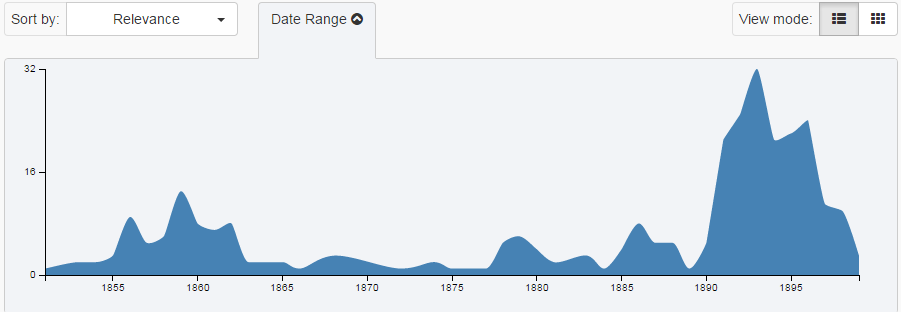
Date Range
Once you’ve searched a topic, you are also shown a date range, showing the years around which your search results centre


Default collection searches
You can now choose to only search EEBO, ECCO, or BL by default by selection options in the settings.

First go to Settings 


Then go to the Collections option and select which collection you want to search by default. If you want to reset the search terms to search all of the collections simply


click Reset. 

Tuesday, 5 January 2016

Inter-site delivery now available to School of Art


Staff and Students at the School of Art can now use Primo, the library catalogue to request books be delivered to the department.

Lloyd Roderick, Panoramic classmark N, 2015
In a new service, students (and staff) at the School of Art can now request books be delivered to the department.  Doing so is easy - find the book you need in Primo, then click Find and Request.  Then, click Request.  You then need to fill in the form and choose School of Art as the Pickup Location, and a date after which you do not require the item anymore.


You'll then be sent a message via email saying where the book can be picked up and by when.  When you collect the book, a slip will be included saying where and how to return the book.

Some of the books in section N, level F, Hugh Owen Library, awaiting perusal.

You can still use the library as normal and there's no better way of finding useful material than browsing the stacks of materials in the art section (section N, Level F).  If you need any help with using this service, or for any library and information question, you can drop by to see me at the School of Art on Tuesday afternoons (restarting this term on 19 January 2016), or contact me by email to arrange an appointment.

Lloyd Roderick
Subject Librarian - Art

Friday, 4 December 2015

e-books: the solution to, and cause of, most of our problems


Have you seen an e-book for sale on Amazon, asked the library to buy it, and been told that there is no electronic version of that book available? Are you looking for an e-book you read a few months ago, but it no longer works? It’s very annoying – and I can assure you that we in Information Services share your annoyance. Our policy is that e-books are the way forward. They enable us to dramatically increase the range and number of titles available to our users, at reduced cost and with no impact on our limited shelf space. Many (although by no means all) of our users prefer working with e-books over print, citing the speed and ease of searching, and the ability to access hundreds of thousands of titles from anywhere in the world, at any time. But in spite of the undoubted benefits that e-books bring, there are many problems – and I shall attempt to summarise these now.

E-book publishing is a new, complex, and constantly changing field. We try our best to source e-books whenever they are requested, but sometimes we are simply not able to. With e-books, it is the publishers who decide the price, licencing terms, digital rights management, number of simultaneous users, and so on, which subsequently determines whether we can purchase the book. Most publishers make their e-books available on aggregator sites (such as ebrary or Dawsonera, the sites which host the vast majority of our e-books) and can be purchased by libraries on an institution-wide basis; some publishers do not. Human Kinetics is one such publisher.  They will not sell to institutions, only to individual users. The reason for this is very easy to explain: money. They will make more money by selling twenty copies of the e-book to twenty individual students than they would by selling one copy to a library that those twenty students could then share.

We have investigated various ways of informing staff and students of this sort of limitation, such as maintaining a list of publishers who don’t sell e-books to institutions, but it is not that straightforward. The e-book licencing goalposts are constantly shifting, and it is very difficult to manage. Springer, for example, does not sell individual titles on institution-wide basis, but they do sell e-book packages to libraries. OUP is another complicated one; originally its content was available via Dawsonera, but then two years ago OUP built its own platform called Oxford Scholarship Online (OSO). We bought one e-book on OSO; now OUP has removed a lot of the content from that platform, put all the legal titles onto another new platform (called LawTrove), which only individuals can access, and put other e-books for sale, again only to individuals, via Amazon and other third party vendors. Then there’s Pearson, who do make their content available to libraries via Dawsonera, but every six months or so change the licencing terms to make them less favourable (reducing the number of uses allowed in a year, reducing the number of simultaneous users, removing the ability to download for offline reading, increasing the price…). It’s not just Dawsonera that has content withdrawn from it; the titles available to us via our ebrary subscription change frequently, with hundreds of new titles being added to, and dozens of titles being removed from, the collection each month. The sheer scale of the changes makes this difficult to manage, but we are currently working on a way of supressing the removed titles from the catalogue and ordering replacement copies if necessary.

The variety of different platforms, the inconsistency of licence terms from publisher to publisher, and the fact these terms are in a constant state of flux, all serve to frustrate and alienate our users. There are limits to what we can do to change this situation, although we are making some progress: HE libraries, and JISC, negotiate with publishers en masse to secure favourable pricing and terms where we can – but these tend to be for large multi-title packages with the big publishers. Also, JISC has recently written to Pearson on behalf of all HE institutions to express our collective displeasure at the way the company is increasingly frustrating our efforts to offer a decent service to our students. There has been no response from Pearson yet, but there was no small amount of schadenfreude in the library a few weeks ago when their share price plummeted and they were forced to issue a profits warning.

I am confident that e-books will one day be the best way for academic libraries to deliver content to their users, but until access is uniformly seamless, reliable, and cost-effective, e-books are also a source of great frustration for staff and students. I appreciate that frustration, but can assure you that we feel just as strongly and we are doing all we can to manage this difficult situation, and provide our users with the resources they need.

I hope that this has gone some way to addressing some of the main concerns about e-books, and provided an explanation for the current situation. If you have any further questions, or suggestions for how we might improve this service, please do get in touch with us at ejournals@aber.ac.uk.

Wednesday, 2 December 2015

Avoiding Plagiarism a new online course

Purchased by the School of Management and Business, a fantastic new resource - Avoiding Plagiarism, an interactive, online course provided by Epigeum – is now available for use by all Aberystwyth University students.

The course is broken down into three units:

What is plagiarism?
The first unit discusses what plagiarism is, some of the terms you might come across, intentional and unintentional plagiarism and the ways in which assessors can detect plagiarism.

Referencing
Unit 2 covers the importance of referencing, referencing systems used and the difference between references and citations.

Avoiding Plagiarism.
Unit 3 outlines way in which plagiarism can be avoided. (Epigeum, 2014)

The course is quite comprehensive and provides a number of practice scenarios, a summary and a quiz at the end. The pass-mark for the quiz is 75% and there is a certificate for all those who pass!

A link to the course is here: https://plagiarism.epigeum.com/

You need to register and you have to provide your full Aberystwyth email address. A confirmation link will then be sent through to you and you are good to go from that point on.

EPIGEUM (2014), Avoiding Plagiarism [Online]. Available from: https://plagiarism.epigeum.com/courses/plagiarism/index.php?course_id=7&user_id=57292&s=0ptcs59dl6lu1r69aeuu3c9u06 [Accessed: 04/11/2015]