Monday, 2 July 2018
New, improved Aspire Reading List page for BlackBoard
The advice previously displayed in the left panel of the Aspire Reading List page in Blackboard can now be found by clicking the menu button next to the page title, so that the reading list can use the full width previously taken by both panels.
Please contact the Academic Engagement team by acastaff@aber.ac.uk or phone 01970621896 if you have any questions.
Thursday, 10 May 2018
Aber LibTeachMeet 2018 - How can we make the library more inclusive?
Aberystwyth University is well known for providing one of the best student experiences in the UK and a large part of that is down to the strong sense of belonging that we foster, not only with students and staff but with the wider community too.
This year’s
Aber LibTeachMeet focusing on inclusivity was a great opportunity to examine
what it is we are currently doing so well but also to explore what else we can
do both as individuals and as an institution to more actively meet the diverse
needs of our users and to make the library as inclusive as possible to
everyone.
We prepared
ten presentations exploring various elements of inclusivity - accommodating the
needs of international or bilingual students, supporting those with sight impairments
or those who stammer or building inclusivity by encouraging students to read.
The event
itself reflected the topic discussed. Speakers came from four different
institutions – Aberystwyth University, University of Leicester, Sheffield
Hallam University and Swansea University. Also, three different departments from
within Aberystwyth University were represented – the International Student
Centre, Student Support, and Information Services. The atmosphere was informal
and kind, we openly discussed ideas, asked questions and expressed appreciation
for shared experiences.
The day started with a subject librarian, Lloyd Roderick, who gave a presentation on his experience of teaching information literacy bilingually. He shared a few useful resources such as Esboniadur and Gwerddon for helping to support students studying in the Welsh language.
Lloyd’s talk was followed by Yvonne Rinkart from the International Student Centre who presented the findings of a short study exploring international foundation students’ library usage. One of the points raised by Yvonne was that international students are more susceptible to ‘library anxiety’ – the feeling of being confused and overwhelmed that libraries can sometimes induce.
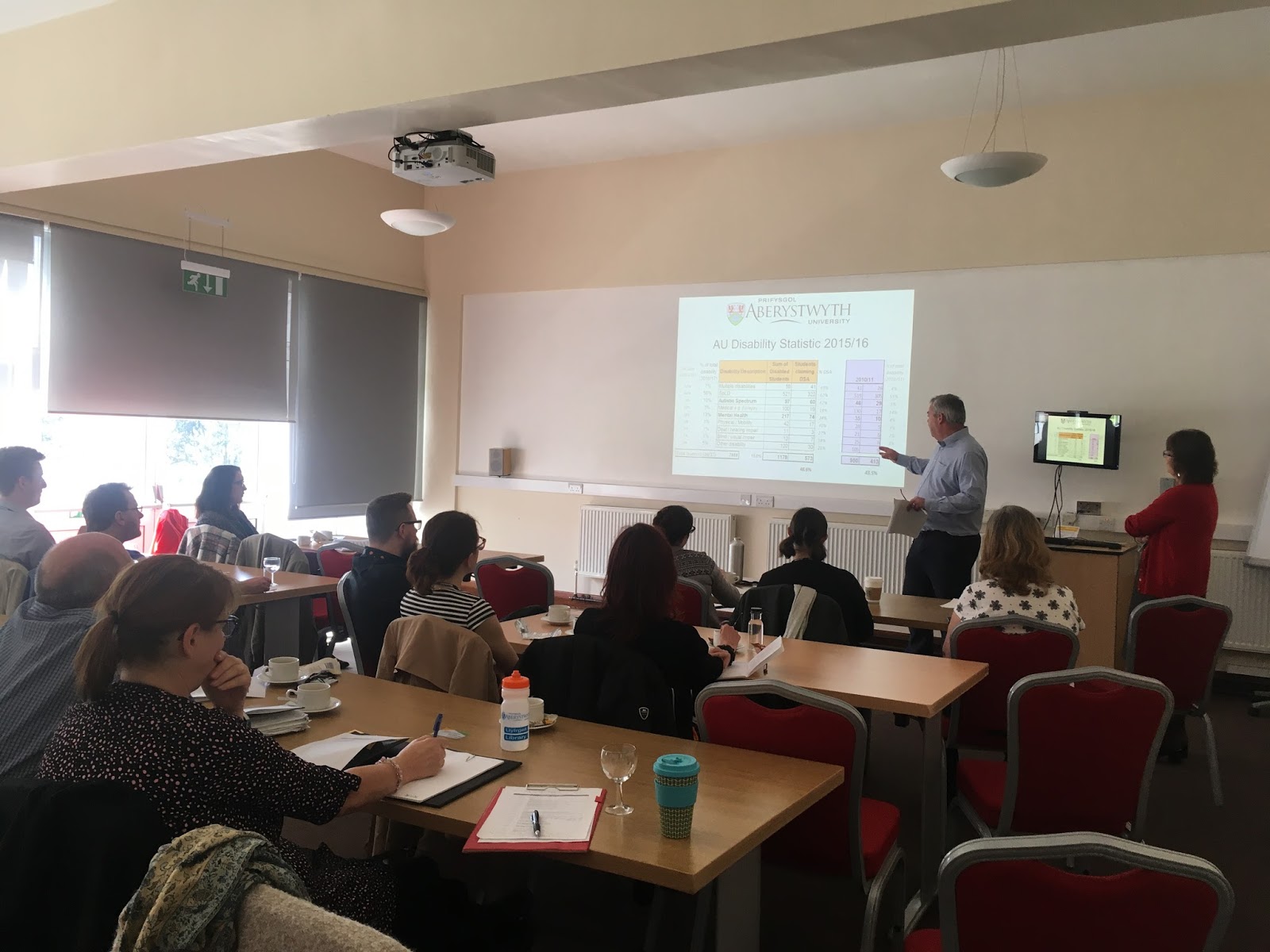
The next presentation given by John Harrington and Diane Jones, speakers from the Student Support Centre, gave us a good overview of the disability services they provide along with statistics for Aberystwyth University, and explained what inclusion really means.
We had the opportunity to look at inclusivity from the student perspective too. A recent AU graduate, Cerys Davies, talked about her experience of using library services as a student with sight impairments. The talk inspired a wave of positive comments and questions. Among many other valuable points, Cerys talked about the difficulty she faced in obtaining accessible reading materials.
Our first external speakers of the day were Harinder Matharu and Adam Smith who had joined us from the University of Leicester. They gave us an overview of the two initiatives contributing to their inclusive university environment - Read at Leicester and Unearthing Histories. Deepening the sense of belonging of minority groups by exploring their history in university’s archives was a truly inspiring idea.
One of the IT Helpdesk crew members – Alice Farnworth talked about the
benefits of embedding DSA software training within our library service. She
presented us with a variety of assistive tools, of which some such as
Read&Write or Inspiration are available on public computers at Aber.
Next up, Philippa Price, who has been shortlisted for the Welsh Librarian of the year Award, told us about the Inclusive Services Group set up at Swansea University. Philippa talked about a broad range of initiatives the Group is organizing and promoting, such as creating recommended reading lists for the LGBT community or putting together dignity packs for homeless women.
Hannah Dee, a lecturer from the Computer Science Department talked us through the idea of improving students’ writing and the ability to read by setting up a science-fiction book club for students and staff from her department. Hannah also introduced us to some interesting books, for which we are very grateful.
Next up, Philippa Price, who has been shortlisted for the Welsh Librarian of the year Award, told us about the Inclusive Services Group set up at Swansea University. Philippa talked about a broad range of initiatives the Group is organizing and promoting, such as creating recommended reading lists for the LGBT community or putting together dignity packs for homeless women.
Hannah Dee, a lecturer from the Computer Science Department talked us through the idea of improving students’ writing and the ability to read by setting up a science-fiction book club for students and staff from her department. Hannah also introduced us to some interesting books, for which we are very grateful.
Another visiting speaker, Paul Conway from Sheffield Hallam University, discussed accessible templates for presentations and hand-outs and other tips on being inclusive in the classroom. Kate Wright from the Aberystwyth University E-Learning Group delivered a short presentation on supporting users with a stammer. Kate raised a few interesting points including stammering not being perceived as disability, although it is classified as one. She also discussed the stereotypes surrounding stammering.
As with our
last three LibTeachMeets this was a fantastic forum for not only reflecting on
current practice but for generating the new ideas necessary for us to continue
to build on our reputation for inclusivity in a diverse and fast-changing
environment. We received positive feedback from speakers and attendees who described
the programme as interesting, varied, informative and thought-provoking. We
greatly appreciate all who joined in and we hope it will generate some great
ideas that will assist in our aim of increasing the awareness and accessibility
of both the library facilities and the services on offer here.
Tuesday, 27 February 2018
What do students think about reading lists at Aber?
One of the Information Services Focus Groups that we conducted this year explored the students’ experience of using Aspire reading lists as part of their studies. Feedback gathered from the students revealed the following:
- Students would like to see what’s on the reading list before registering for a module.
- Reading lists should include all the necessary resources for the course and enable the students to build on the knowledge gained in lectures through further reading.
- Students really liked those lists which were organised with week-by-week sections.
- The way the books on the reading lists linked through to Primo was seen as being very useful and the students thought it would be great if this was consistent across all modules.
- Overly-long lists were sometimes felt to be a bit off-putting.
- Whilst the reading list on Blackboard was well liked by students they thought it would be useful if they were introduced to the Aspire system too. The additional features that it provides, particularly the facility to create and export bibliographies, was seen as being really helpful.
Subject librarians will happily assist module co-ordinators in creating or updating their Aspire reading lists. Additionally, librarians are also available to provide quick demonstrations of the Aspire system and its features to students.
Please contact your subject librarian or the Academic Engagement Team at acastaff@aber.ac.uk or on 01970621896. We're happy to meet at a time and place convenient for you.
Friday, 26 January 2018
Open Access Filtering Introduced in Web of Science
In the latest update to the Web of Science interface, accessible through Primo Resources A-Z tab (http://primo.aber.ac.uk) or directly at http://wok.mimas.ac.uk, the facility to filter your search results to show only those items available through Open Access has been introduced. Using software developed by ImpactStory, links are provided to peer-reviewed or final versions of Open Access papers, published through either the Gold OA route (usually involving payment of Article Processing Charges for immediately availability) or the Green OA route (achieved by depositing the author's postprint in an institutional repository).
In the initial Web of Science results list, all the Open Access records are now identified using the standard OA logo for easy identification.
The latest Web of Science White Paper on Open Access and Open Access poster have full details of this new facility.
Steve Smith
Academic Engagement Group
In the initial Web of Science results list, all the Open Access records are now identified using the standard OA logo for easy identification.
The latest Web of Science White Paper on Open Access and Open Access poster have full details of this new facility.
Steve Smith
Academic Engagement Group
Wednesday, 20 September 2017
Improvements and new features in Primo
Here's a quick recap:
Expanded Advanced Search available in all search tabs
Search suggestions - give them a try, see what happens!
Find the Information Skills pages
After finding a book, click Shelf View to see the books sitting on the shelf next to the one - they might also be useful for you
Contact acastaff@aber.ac.uk for further information or to arrange a demonstration.
Expanded Advanced Search available in all search tabs
Search suggestions - give them a try, see what happens!
Find the Information Skills pages
After finding a book, click Shelf View to see the books sitting on the shelf next to the one - they might also be useful for you
Contact acastaff@aber.ac.uk for further information or to arrange a demonstration.
Friday, 14 July 2017
DG Research and Innovation Expert Group on Altmetrics Report
The EC Directorate Research and Innovation's Expert Group on Altmetrics was set up to consider how to advance Article-Level publication metrics (altmetrics) in the context of the open research agenda, to review different altmetrics measures in relation to more established methods of measuring research output, how to remove the current barriers to open research/open science and to recommend infrastructures to help embed open research in academic culture. Their report "Next-Generation Metrics: Responsible metrics and Evaluation for Open Science" recommends that the EC should provide clear guidelines for the responsible use of metrics to support open research in the next Research Framework programme (FP9) that research should be undertaken on the potential for gaming any new altmetrics proposed for FP9 before their introduction.
Subscribe to:
Posts (Atom)