Monday, 20 May 2019

Literature Online: new platform August 1st 2019

Literature Online is migrating to a new platform on August 1st at this location: https://search.proquest.com/lion

Please find here ProQuest’s description of the highlights.

All bookmarks and links will direct automatically to the new Literature Online.


Important: if you have stored records, searches etc. in My Archive, these will not be transferred so if you need them please log in and retrieve them now: https://literature.proquest.com/


Both platforms are currently running simultaneously but the old one will be switched off on August 1st.


Contact acastaff@aber.ac.uk for further information or to arrange a demonstration.

Monday, 13 May 2019

EndNote X9 desktop software: now free to download for AU students and staff


Due to a change in licensing, EndNote reference management software can now be downloaded at no cost to Windows and Mac computers owned by AU students and staff. 
  • Log into the software download page: https://faqs.aber.ac.uk/907 
  • Choose Windows or Mac from the Operating Systems menu
  • Find EndNote X9 in the software menu, click Download and follow the instructions
FYI EndNote can already be downloaded to institution-owned computers via the AU Software Centre: https://faqs.aber.ac.uk/2614

Find out more about how EndNote can support your research by storing and formatting your references, and where to get training and advice at Aber.

Contact the Academic Engagement team by email acastaff@aber.ac.uk or phone 01970621896 if you have any questions.


Friday, 7 December 2018

Try the new List View in Aspire

Aspire Reading Lists has been upgraded, introducing some changes to the way that reading lists look when you view them in Aspire.

There will be no change to Aspire reading lists as they appear in Blackboard modules except for  IMLA Distance Learners who will see the changes described here.

Staff who log in to edit lists in Aspire can change any list back to the previous layout by clicking Exit Beta for a limited period.

Viewing lists: improvements
  • Book jacket images are included in list items
  • Click on a title to expand list item information  
  • View your list / list sections in a citation style of your choice
  • You can click View: All to filter list items by Essential or Further reading, reading intentions and study notes.
Viewing lists: changes
  • Use the globe shortcut to toggle between Welsh and English
  • If you use the View: All button to filter Physical or Online Resources: the information you see may incorrectly infer that something isn't available in a particular format when it is (depending on how items have been added to Aspire, or how they are co-catalogued in Primo)
  • To find a direct link to an item: click the 3-dot action menu to the right of the item and click Share item
Staff editing lists: changes
  • The Publish button no longer appears in the Edit menu; click Edit > Edit (Classic) to find the Publish button on the right of the page
  • Find the Edit button in the middle or right of the page, rather than on the left 
  • The Dashboard button is now in the View & Export menu and it is called Analytics
Subject librarians are happy to demonstrate the new List View features - please contact them directly or email acastaff@aber.ac.uk / phone 1896 with any questions you have or to arrange a visit.

Tuesday, 14 August 2018

Aberystwyth University wins runner-up in Excellence in Marketing and Engaging Academics at Talis Insight Europe 2018

We are delighted to share the news that Aberystwyth University has won runner-up in Excellence in Marketing and Engaging Academics category awarded by Talis at their annual conference in May, after achieving published lists for 100% of undergraduate module taught in 2017-2018. Talis Insight Europe 2018 took place at the Birmingham Repertory Theatre with the awards ceremony taking place next door at the spectacular Library of Birmingham.

The award was collected by Joy Cadwallader of the Academic Engagement team, Hugh Owen Library. We would like to thank all our partners in academic departments and professional services at Aberystwyth University for engaging with Aspire Reading Lists.

Monday, 2 July 2018

New, improved Aspire Reading List page for BlackBoard


The advice previously displayed in the left panel of the Aspire Reading List page in Blackboard can now be found by clicking the menu button next to the page title, so that the reading list can use the full width previously taken by both panels.

Please contact the Academic Engagement team by acastaff@aber.ac.uk or phone 01970621896 if you have any questions.

Thursday, 10 May 2018

Aber LibTeachMeet 2018 - How can we make the library more inclusive?


Aberystwyth University is well known for providing one of the best student experiences in the UK and a large part of that is down to the strong sense of belonging that we foster, not only with students and staff but with the wider community too. 

This year’s Aber LibTeachMeet focusing on inclusivity was a great opportunity to examine what it is we are currently doing so well but also to explore what else we can do both as individuals and as an institution to more actively meet the diverse needs of our users and to make the library as inclusive as possible to everyone. 

We prepared ten presentations exploring various elements of inclusivity - accommodating the needs of international or bilingual students, supporting those with sight impairments or those who stammer or building inclusivity by encouraging students to read.

The event itself reflected the topic discussed. Speakers came from four different institutions – Aberystwyth University, University of Leicester, Sheffield Hallam University and Swansea University. Also, three different departments from within Aberystwyth University were represented – the International Student Centre, Student Support, and Information Services. The atmosphere was informal and kind, we openly discussed ideas, asked questions and expressed appreciation for shared experiences.

The day started with a subject librarian, Lloyd Roderick, who gave a presentation on his experience of teaching information literacy bilingually. He shared a few useful resources such as Esboniadur and Gwerddon for helping to support students studying in the Welsh language.

Lloyd’s talk was followed by Yvonne Rinkart from the International Student Centre who presented the findings of a short study exploring international foundation students’ library usage. One of the points raised by Yvonne was that international students are more susceptible to ‘library anxiety’ – the feeling of being confused and overwhelmed that libraries can sometimes induce.

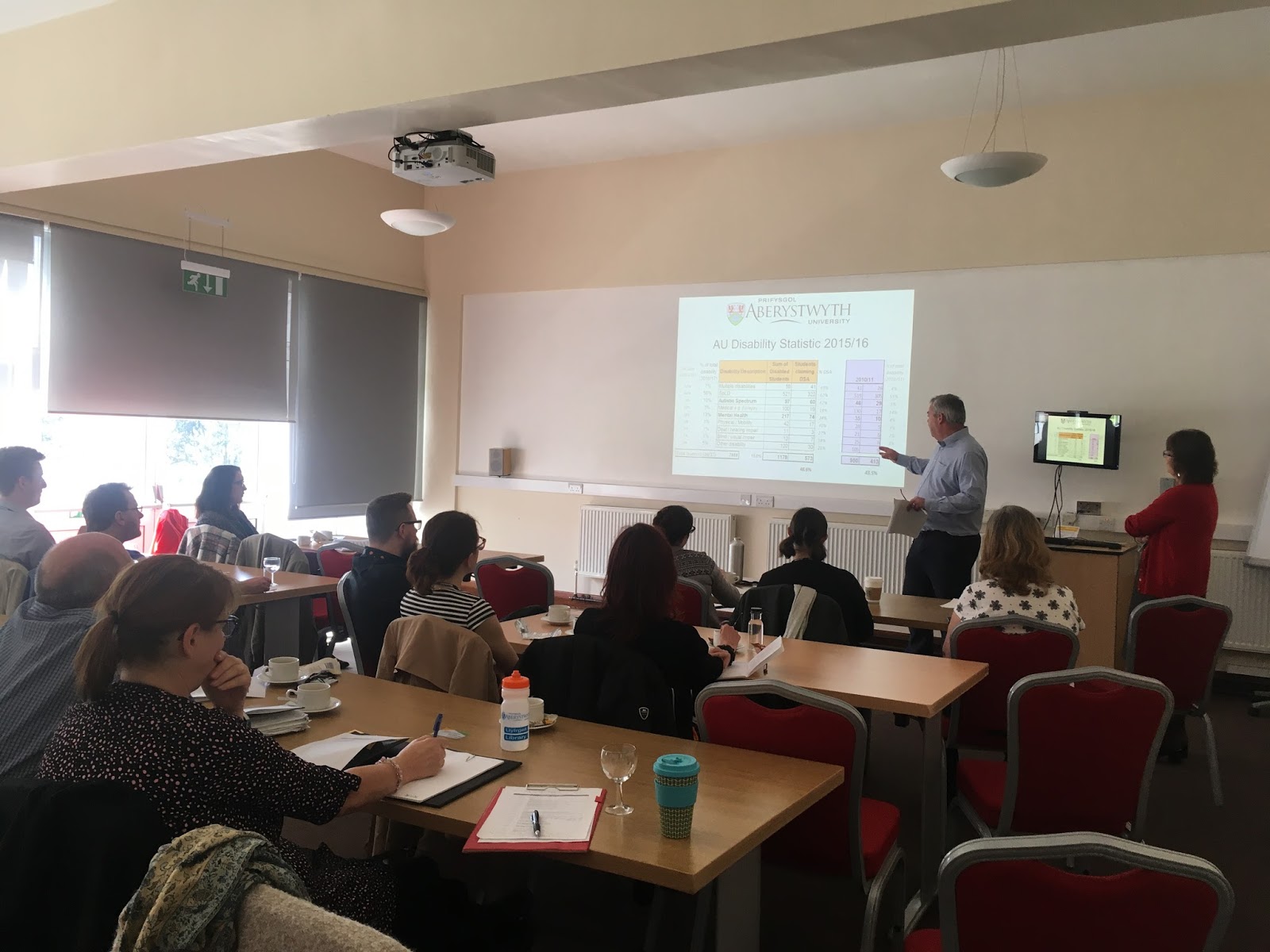
The next presentation given by John Harrington and Diane Jones, speakers from the Student Support Centre, gave us a good overview of the disability services they provide along with statistics for Aberystwyth University, and explained what inclusion really means. 


We had the opportunity to look at inclusivity from the student perspective too. A recent AU graduate, Cerys Davies, talked about her experience of using library services as a student with sight impairments. The talk inspired a wave of positive comments and questions. Among many other valuable points, Cerys talked about the difficulty she faced in obtaining accessible reading materials.

Our first external speakers of the day were Harinder Matharu and Adam Smith who had joined us from the University of Leicester. They gave us an overview of the two initiatives contributing to their inclusive university environment - Read at Leicester and Unearthing Histories. Deepening the sense of belonging of minority groups by exploring their history in university’s archives was a truly inspiring idea.

One of the IT Helpdesk crew members – Alice Farnworth talked about the benefits of embedding DSA software training within our library service. She presented us with a variety of assistive tools, of which some such as Read&Write or Inspiration are available on public computers at Aber. 

Next up, Philippa Price, who has been shortlisted for the Welsh Librarian of the year Award, told us about the Inclusive Services Group set up at Swansea University. Philippa talked about a broad range of initiatives the Group is organizing and promoting, such as creating recommended reading lists for the LGBT community or putting together dignity packs for homeless women. 

Hannah Dee, a lecturer from the Computer Science Department talked us through the idea of improving students’ writing and the ability to read by setting up a science-fiction book club for students and staff from her department. Hannah also introduced us to some interesting books, for which we are very grateful.


Another visiting speaker, Paul Conway from Sheffield Hallam University, discussed accessible templates for presentations and hand-outs and other tips on being inclusive in the classroom. Kate Wright from the Aberystwyth University E-Learning Group delivered a short presentation on supporting users with a stammer. Kate raised a few interesting points including stammering not being perceived as disability, although it is classified as one. She also discussed the stereotypes surrounding stammering. 

As with our last three LibTeachMeets this was a fantastic forum for not only reflecting on current practice but for generating the new ideas necessary for us to continue to build on our reputation for inclusivity in a diverse and fast-changing environment. We received positive feedback from speakers and attendees who described the programme as interesting, varied, informative and thought-provoking. We greatly appreciate all who joined in and we hope it will generate some great ideas that will assist in our aim of increasing the awareness and accessibility of both the library facilities and the services on offer here.

Tuesday, 27 February 2018

What do students think about reading lists at Aber?

One of the Information Services Focus Groups that we conducted this year explored the students’ experience of using Aspire reading lists as part of their studies. Feedback gathered from the students revealed the following:

  • Students would like to see what’s on the reading list before registering for a module.
  • Reading lists should include all the necessary resources for the course and enable the students to build on the knowledge gained in lectures through further reading.
  • Students really liked those lists which were organised with week-by-week sections. 
  • The way the books on the reading lists linked through to Primo was seen as being very useful and the students thought it would be great if this was consistent across all modules.
  • Overly-long lists were sometimes felt to be a bit off-putting. 
  • Whilst the reading list on Blackboard was well liked by students they thought it would be useful if they were introduced to the Aspire system too. The additional features that it provides, particularly the facility to create and export bibliographies, was seen as being really helpful.

Subject librarians will happily assist module co-ordinators in creating or updating their Aspire reading lists. Additionally, librarians are also available to provide quick demonstrations of the Aspire system and its features to students. 

Please contact your subject librarian or the Academic Engagement Team at acastaff@aber.ac.uk or on 01970621896. We're happy to meet at a time and place convenient for you.


Friday, 26 January 2018

Open Access Filtering Introduced in Web of Science

In the latest update to the Web of Science interface, accessible through Primo Resources A-Z tab (http://primo.aber.ac.uk) or directly at http://wok.mimas.ac.uk, the facility to filter your search results to show only those items available through Open Access has been introduced. Using software developed by ImpactStory, links are provided to peer-reviewed or final versions of Open Access papers, published through either the Gold OA route (usually involving payment of Article Processing Charges for immediately availability) or the Green OA route (achieved by depositing the author's postprint in an institutional repository).

In the initial Web of Science results list, all the Open Access records are now identified using the standard OA logo for easy identification.


The latest Web of Science White Paper on Open Access and Open Access poster have full details of this new facility.

Steve Smith
Academic Engagement Group

Wednesday, 20 September 2017

Improvements and new features in Primo

Here's a quick recap:

Expanded Advanced Search available in all search tabs


Search suggestions - give them a try, see what happens!


Find the Information Skills pages

After finding a book, click Shelf View to see the books sitting on the shelf next to the one - they might also be useful for you


Contact acastaff@aber.ac.uk for further information or to arrange a demonstration.

Friday, 14 July 2017

DG Research and Innovation Expert Group on Altmetrics Report


The EC Directorate Research and Innovation's Expert Group on Altmetrics was set up to consider how to advance Article-Level publication metrics (altmetrics) in the context of the open research agenda, to review different altmetrics measures in relation to more established methods of measuring research output, how to remove the current barriers to open research/open science and to recommend infrastructures to help embed open research in academic culture. Their report "Next-Generation Metrics: Responsible metrics and Evaluation for Open Science" recommends that the EC should provide clear guidelines for the responsible use of metrics to support open research in the next Research Framework programme (FP9) that research should be undertaken on the potential for gaming any new altmetrics proposed for FP9 before their introduction.

Tuesday, 27 June 2017

Aberystwyth LibTeachMeet 2017


This year’s theme at the Aberystwyth LibTeachMeet was ‘Information Literacy in the Age of Fake News’ a challenging issue facing libraries and their readers. The CILIP Information Literacy Group kindly sponsored the event.

Librarians and information professionals working in higher and further education were amongst the attendees and it was apparent that we all faced similar issues in student engagement, especially when promoting information literacy. Customer Services and Academic Engagement Managers, Nia Ellis and Elizabeth Kensler opened this year’s TeachMeet. Nia and Elizabeth reiterated that fake news posed a considerable threat to information literacy and they hoped that this TeachMeet would inspire some innovative ways to combat it.

We began with ‘The One Armed Bandit of News’ icebreaker, where I put our attendee’s fake news detection skills to the test. Loosely based on a certain long running satirical news show, two humorous headlines were shown and it was up to the attendees to decide on which they thought was the ‘real’ headline. The icebreaker proved that even as information professionals it can be somewhat difficult to sift fact from fiction.

The first talk of day was An Alternate History of Alternative Facts presented by myself. I spoke about the different types of fake news and discussed a few downright sinister examples from history, explaining that fake news is by no means a recent phenomenon. Our next speakers were Dr Amy Staniforth and Simon French of Aberystwyth University with Facts Matter: Truth, Memory and Metadata. Simon and Amy examined the “librarians’ agenda” when providing accurate information and metadata. The talk inspired a rather heated, but good natured debate about the ethics of censorship in libraries. 

Next up, Julie Archer and Tom Francis of Aberystwyth University presented a historical case study of Professor Herman Ethè, a shameful episode in Aberystwyth's history. Tom an acquisitions librarian, who has also written a play about the ill-fated professor, gave a detailed account of the larger than life character who found himself at odds with the local townsfolk. Julie, Records Manager and Archivist delved deep into the Aberystwyth University archives to show the wave of anti-German hysteria, which had taken hold of the town following an intense propaganda campaign in the First World War. Our first external speaker of the day was Catherine Finch, who had joined us from Cardiff Metropolitan University. In DuChamp’s Bicycle: teaching students about keywords in searching, Catherine demonstrated an effective exercise she uses to get students to think about keywords in relation to searching on the internet.

Our second external speaker was Jacinta Jolly of NPTC Group of Colleges. Jacinta kicked off the after-lunch talks with a perspective from further education, reviewing critical literacy teaching. Jacinta discussed the perennial issue of student engagement with initiatives and demonstrated some effective strategies to encourage students to take part. She finished her talk with a fun ‘kahoot!’ critical thinking quiz, which motivated some friendly competition amongst the attendees. Finally, Joy Cadwallader subject librarian at Aberystwyth University presented Embedding in the curriculum: first steps in fake news. Joy discussed some future ideas for teaching fake news including using musical clues, the choice of the Fleet Foxes rounded off the day nicely!

There was plenty of commentary and photos shared on twitter thanks to our own dedicated hashtag #AberLTM17. I would like to thank the CILIP Group for kindly sponsoring this year’s TeachMeet and our attendees who had travelled from the length and breadth of Wales. I would also like to thank our speakers who delivered excellent, thought provoking presentations.

Keep your eyes peeled for Aber LibTeachMeet 2018!

Tuesday, 30 May 2017

Resource of the Month: European Sources Online


European Sources Online is an extensive online database which forms part of the University’s European Documentation Centre.
It provides access to the latest information on the European Union, including primary and official documentation on policies, institutions and countries.The ESO database also provides access to;·        Thousands of selected EU documents and statistical records
·        EU publications, news articles and website links
·        Bibliographic records to important academic texts and journal articles
·        Unique Information Guides which explore key topics within Europe
·        Information on current and past issues affecting EU citizens

European Sources Online can be accessed from the University network at http://www.europeansources.info/search.jsp
For further information, the European Sources Online’s FAQ page can be found at http://www.europeansources.info/about.jsp
If accessing European Sources Online away from campus, you must connect via the University’s VPN: https://www.aber.ac.uk/en/is/it-services/vpn/


Thursday, 20 April 2017

Resource of the Month: Nexis


Nexis is an online full-text database which searches regional, national and global newspapers from over 100 countries, business and industry trade magazines, business news and company information.

• This resource is often used to aid businesses as it provides insights into over 30,000 trusted and invaluable sources of business and news information. These range from global news articles, to company records and additional legal information.

Why the resource is useful for students;

Nexis helps to prepare for job interviews and careers – the database can be used to gain insight over others within the current job market. This is through the ability to monitor and obtain crucial information about specific companies and job sectors.

It can be used to aid research for assignments and dissertations – the vast database allows users to research and reference approved news sources, business statistics and bibliographic references within their work.

• The resource’s varied document types can be used to aid research within a wide range of degree subjects – the main types of accessible documents include;

UK and international news sources
Business and trade publications
Company profiles
Company, country and industry reports
Market insights
Biographical data
International and emerging market sources
US public records
Legal information

Access Nexis from the University network at: https://www.nexis.com/home/home.do?randomNum=0.6811372427443615

If accessing Nexis away from campus, connect via the University’s VPN: https://www.aber.ac.uk/en/is/it-services/vpn/

Nexis training resources including video tutorials and downloadable guides can be found here: http://help.bisuktraining.lexisnexis.co.uk/about-nexis

Contact acastaff@aber.ac.uk for further information or to arrange a demonstration.

Wednesday, 5 April 2017

Forum for Responsible Research Metrics


In 2015, an independent report entitled "The Metric Tide" chaired by Prof James Wilsdon of the Science Policy Research Unit (Univ Sussex) drew attention to the rising pressure on universities, research funders and policymakers to use quantitative metrics in the assessment of research quality and productivity.  In the opinion of many academics and information professionals, however, the current levels of understanding of  the ways in which such measures are calculated, described and used is not high and can lead to inappropriate conclusions being drawn and unintended negative publishing behaviours developing.

To address these matters, the Forum for Responsible Research Metrics has been set up by a partnership of HEFCE, RCUK, Universities UK, Wellcome and JISC in September 2016 to develop the understanding, transparency and flexibility of research metrics as applied throughout the UK research and funding communities. Under the chairmanship of Prof David Price, Vice-Provost (Research) at the University College London, the Forum will advise all UK higher education funding bodies as to how research metrics might best be used in assessing research outputs and environments, Such advise will have particular relevance in terms of the consultations currently taking place on the structure of the next Research Excellence Framework (REF) exercise scheduled for 2021.

Steve Smith
March 2017

Thursday, 9 March 2017

Resource of the Month: Web of Science

Web of Science is an online resource available at Aberystwyth University.

It gives access to thousands of easily searchable scientific journals, publications and citations within its Master Journal List.

How the resource can help students;

  • Helps to aid research for assignments, dissertations and exams – The database offers easy access to the latest academic research, texts and bibliographic references.
  • The database covers a wide range of subjects – Its core collection of scholarly journals covers not only science subjects, but also social sciences and arts and humanities.
  • Various other worldwide databases can be accessed within the Web of Science collection – these include the U.S. National Library of Medicine’s MEDLINE database, the BIOSIS biosciences database and the Russian Science Citation Index.

Types of accessible documents within the database include;

  • Journal articles
  • Book chapters
  • Biographical items
  • News items
  • Bibliographies

Web of Science can be accessed online from the University Network at: http://wok.mimas.ac.uk 
or from http://apps.webofknowledge.com/ or connect from the Primo Resources A-Z tab under W.

If accessing Web of Science away from campus, connect via the University's VPN:
https://www.aber.ac.uk/en/is/it-services/vpn/ 

Video tutorials can be accessed here:
http://wokinfo.com/training_support/training/web-of-knowledge/

Web of Science's Quick Reference Guide can be found at:
 http://wokinfo.com/media/pdf/qrc/webofscience_qrc_en.pdf 

Contact acastaff@aber.ac.uk for further information or to arrange a demonstration.


Monday, 6 March 2017

A new resource for Students and Staff: Globe on Screen


We are thrilled to announce that we have recently acquired access to an exciting new online resource, available on the Drama Online platform. Globe on Screen allows access to 20 Shakespeare productions filmed live at the Globe Theatre in high definition and surround sound.

See the full list here.

You can also find the plays when searching in Primo. Simply search for the production you require, filter by online access and find the video option. Finally, click the View Online tab and click the Globe on Screen hyperlink to take you to the production. If you are watching from home, remember to have your Aber VPN set up! 


Please contact acastaff@aber.ac.uk for further information or to arrange a demonstration.

Thursday, 23 February 2017

Links to digitised documents to be added to Aspire Reading Lists

As of Tuesday 28th February, reading lists requiring articles and/or chapters to be digitised will be processed in a new way to streamline the service for students.
Digitised readings e.g. books chapters or journal articles for seminars etc. are currently deposited in a folder in your Blackboard module called Digitised Documents.
 
Students
From 2017-2018 you will be able to click through to digitised documents from the corresponding items in the Aspire Reading List.
  • Find the Aspire Reading List in the left menu of your Blackboard module.
  • You may need to enter your Aber username and password to access the first document you open
Staff
In the new process, links to digitised articles and chapters will be pasted directly into the corresponding items in the Aspire reading list by library staff who will then republish the list. Subsequently when a student clicks on the article or chapter in the Aspire reading list in Blackboard, they will click through directly to the digitised document.
This change is taking place on a rolling basis. If you publish a new reading list, or re-publish one for which nothing has been digitised for this academic year, it will get the new treatment. If you re-publish your list to get a few extra digitisations for a module that is currently running, library staff will add the readings to the existing Digitised Documents folder in the Blackboard module.
Module co-ordinators will want to bear this change in mind when updating Aspire lists for the new academic year, particularly where they may have added notes to students in the lists and/or in Blackboard referring students to the Digitised Documents folder. Follow these instructions to add further articles or chapters to Aspire lists for digitisation.
Contact your subject librarian or acastaff@aber.ac.uk 01970621896 if you have any questions or would like a quick demonstration.

Wednesday, 15 February 2017

Resource of the Month; Box of Broadcasts

Box of Broadcasts provides access to over one million free on demand television and radio programmes for learning, research and teaching purposes.


Why the resource is useful for students;
  • Box of Broadcasts provides recently aired and older archived television and radio shows which are available to record and view on demand.
  • Box of Broadcasts’ on demand programmes are now available to access and view anywhere across multiple platforms – compatible devices include desktop, iOS, Android and Windows mobiles.
  • Programmes from over 60 Freeview television, radio and foreign language channels are available to view and record – these include BBC, ITV, Channel 4, Channel 5, S4C, Sky News and BBC Radio Cymru.
Visit Box of Broadcasts at: https://learningonscreen.ac.uk/ondemand/listings

If accessing Box of Broadcasts away from campus, connect via the University’s VPN first:

Watch this video tutorial about how to use Box of Broadcasts:

Contact acastaff@aber.ac.uk for further information or to arrange a demonstration.

Wednesday, 4 January 2017

New resource IBISWorld – Now Available!

Aberystwyth University has recently purchased IBISWorld


IBISWorld provides industry data for over 400 UK industries with an easy to use search and user friendly reports.

This resource is useful for anyone;

Preparing for interview/job success – find out more about the industry sector the company is operating, competitors, major players and gain a better understanding of the workings of that industry.

Research for assignments/dissertation – IBISWorld provides all the information needed to help understand the operating conditions, and long term outlook of major and niche industries.

Industry Statistics – each industry report provides data and analysis on each industry, explained with clear graphs and data charts. The data charts can easily be exported into Excel and the data is great for SWOT, PESTLE and Porter’s Five Forces analysis.

Each industry report provides;

Detailed performance data and analysis on the market
Supply chain information
Operating strengths and weaknesses
External drivers
Major player market strategies
Industry profit
Cost structure benchmarks

Access IBISWorld online at www.ibisworld.co.uk (no password needed if accessing from the University network).

Video tutorials can be found here: http://clients1.ibisworld.co.uk/about/uk/tutorials/

If accessing IBISWorld away from campus connect via the University VPN: https://www.aber.ac.uk/en/is/it-services/vpn/


Monday, 7 November 2016

Semester 2 deadline for Aspire reading lists: November 30th

Library staff are buying books and digitising now for modules being taught in Semester Two 2016-2017.
Reading lists for modules being taught in Semester 2 (or being taught over both semesters) must be added to Aspire, and existing Aspire lists must updated and republished, by the end of November or there is no guarantee that library materials and digitised documents will be available in time for teaching.

New: are you planning a reading list for a returning module? Check the reading list archive and let us know if you'd like a previously-published Aspire list retrieved for you to re-purpose.

Please contact your subject librarian if you have any questions about this.
You may find these links useful
Please contact your subject librarian or Academic Engagement acastaff@aber.ac.uk 01970621896 if you would like some training or a refresher. We're happy to visit at a time and place convenient for you.